
It was past two in the morning. Every now and then, Arnab would wonder: is heartbreak truly the deepest sorrow in a person’s life?
No.
The deepest sorrow is this—loving someone deeply, yet failing to make them understand a single truth that, had it been known, might have changed the very fate of the relationship.
Arnab had loved twice in his life.
Both times, it was real.
At least, to him.
Early on, he hadn’t even known there was a specific word for his orientation; he only knew he felt somewhat different from the other men around him. It was only after walking a long, solitary road and suffering many broken hearts that he discovered it. Had he understood his own orientation sooner, he might have spent less time crippled by self-doubt. He could have navigated those years with greater confidence, aligning himself with those who understood, and feeling secure in his own emotional geography.
Let us call the first woman Meera. The second, Neela.
They had different temperaments, different laughs, different ways of showing anger. Yet, with both of them, Arnab ultimately arrived at the exact same standstill.
Arnab used to tell himself that he was capable of love, of desire, of romance, and of wanting someone with all his heart.
There was only one thing he could not do.
He could not open the door to intimacy and summon someone in.
To him, attraction did not mean conquest. It meant waiting for the other person’s consent and desire. If someone stepped forward, he could meet them with an open heart. But taking that very first step on his own never felt natural to him.
He learned later in life that there is a name for this.
Reciprosexual.
When Arnab first encountered the word, he sat in silence for a long time.
It felt as though, after all these years, a small lamp had finally been lit in the dark room within him.
Yet, does turning on a light mean anyone else can see what is inside that room?
Meera could not.
One evening, Meera asked him,
“Do you actually find me desirable?”
Arnab was taken aback.
“Why would you ask that?”
Meera was silent for a moment before answering,
“You never seem to want me.”
Arnab reached out and took her hand.
“I do want you.”
“How?”
Arnab had no answer for that.
He wanted to say:
I want you, but not by rushing blindly toward your body. I wait to see how far you step toward me. If you reach for me, I will never turn you away.
But the words would not leave his lips.
Meera was looking for a different answer.
She wanted a man who would take the initiative on his own. Someone who would brush the hair from her face, pull her close, initiate the first kiss, and propose intimacy.
Because Arnab could not do these things, a quiet doubt slowly took root in Meera’s mind.
Does he simply not find me attractive enough?
Doubt is never a solitary thing.
It brings resentment in its wake.
Resentment breeds distance.
And across that distance, one day, another person appears.
Arnab later learned that this other man spoke to Meera in a way Arnab never could.
He wanted her.
Unmistakably.
Without a shred of hesitation.
Perhaps Meera mistook that unmistakable clarity for love.
Or perhaps, to her, that was simply the only true language of love.
Arnab did not know.
Then, one day, Meera said,
“With you, I don’t even feel like a woman.”
Hearing those words, Arnab felt an absolute emptiness hollow out his chest.
He offered no defense that day.
For when a person has fought a lifelong war against their own limitations, they simply have no strength left to protest.
Neela’s story was different.
This time, Arnab was cautious.
He explained the way he was right from the start.
“I can’t always take the first step.”
Neela had smiled.
“I’ll understand.”
Arnab believed her.
For a while, things were wonderful.
They stayed up talking through the night. They walked side by side. They sat in coffee shops, watching the rain streak the glass. Hearing Neela’s laugh, Arnab would think to himself—this is what love is.
Yet, the language of the physical world eventually returned to sit between them.
Neela was waiting.
Arnab was waiting.
Both of them believed the other would understand first.
Both believed the other would make the first move.
Both believed the other would speak first.
Perhaps that is the strangest tragedy of romance—two people wanting the exact same thing, yet drifting apart simply because each is waiting for the other to say it aloud.
One day, Neela said,
“You have never truly wanted me.”
Arnab replied,
“I have never told you no.”
Neela laughed.
There was no love in that laugh.
There was only exhaustion.
“Not saying no is not the same as wanting me, Arnab.”
After that, another man entered Neela’s life.
This man did not wait.
He voiced his desire for her clearly. He came to her. He wanted her without reservation.
For the first time, perhaps, Neela felt what it was like to be profoundly, actively desired.
What hurt Arnab most wasn’t simply that Neela had left for someone else.
The true pain was that, even as she walked away, Arnab still had no idea where he had gone wrong.
For a long time after that, Arnab stopped dating.
His friends would ask,
“What is actually wrong with you?”
Arnab would just smile.
“Nothing.”
Sometimes, he still wished he could flirt.
He wished he could stay up late talking to someone new.
Looking into a woman’s eyes, he might suddenly feel—I want to know this person for a little longer.
Yet he knew that, eventually, they would reach that same familiar threshold in the relationship, and the old question would arise:
“Why don’t you ever want me of your own accord?”
Arnab’s answer remained:
I do want you. It’s just that my language of wanting is different.
Yet the world does not always care to listen to new languages.
The world wants results.
The man must step forward.
The man must speak first.
The man must declare his passion.
The man must reassure the woman that she is desired.
These social scripts are so ancient that no one ever stops to question them: What if a man’s love language is one of patient anticipation, where he waits for the other’s invitation?
What if, rather than fearing rejection, he simply finds the imposition of his own uninvited desire to be deeply uncomfortable?
What if his heart asks only this—
“Come close to me because you want me.”
To Arnab, that was the most exquisite form of intimacy.
Yet he understood that very few people possess the patience to sustain that kind of initiative over time.
Taking the first step once is easy.
Doing it a second time is possible.
But over and over again?
At every single stage of a relationship?
Eventually, fatigue sets in.
Doubt creeps in.
At those moments, it felt to Arnab as though love for someone like him was a locked door, and the key was always kept in someone else’s hand.
One winter night, Arnab was walking alone.
Dry leaves skittered across the pavement on the wind.
Suddenly, it struck him: for all these years, he had looked at his own story as a series of failed romances.
In truth, it was nothing of the kind.
It was simply a genuine love story told in the wrong language.
Meera had loved him as best she could.
And Neela, perhaps, had too.
They simply understood love as something that required the explicit performance of desire.
Arnab understood love differently.
He waited.
He watched for a space to be carved out for him in someone else’s eyes.
And only then would he gently step into that space.
For him, reciprocation was the genesis of love.
For others, initiation was its proof.
Both could be true.
Yet when two truths within the same relationship cannot comprehend each other’s language, the one who suffers most is the person who is left thinking—
“I never turned you away. I only wanted you to want me, too.”
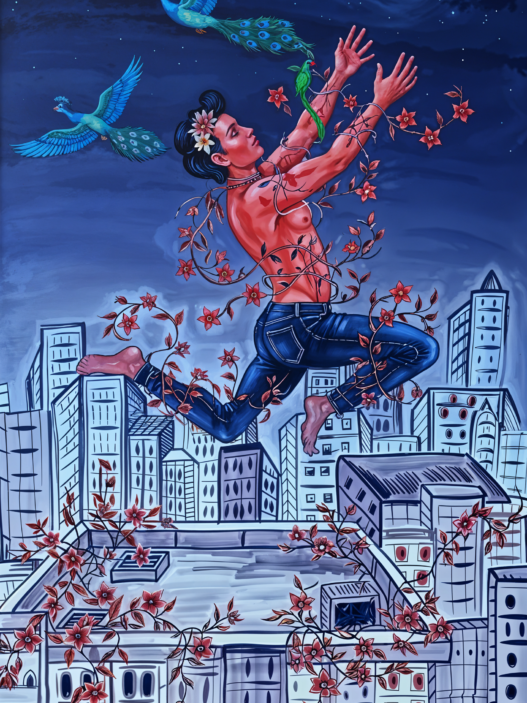
Returning home, Arnab stood by the window.
The lights of the city glittered far in the distance.
He thought to himself: perhaps one day, someone will come who does not mistake his quiet stillness for indifference.
Someone who will understand that not reaching out for your hand first does not mean letting go.
Someone who will understand that—
Just because someone does not summon you of their own accord does not mean they do not want you—it is not always that simple.
Arnab did not know if such a person would ever arrive.
Even so, for the first time in a very long time, he did not open the dating app on his phone.
Instead, he pushed the window open.
The night air was cold.
There were no promises to keep.
No romance to prove.
Only the distant city, and an admission slowly taking root deep within his own chest—
“I love differently.
That does not mean my love is any less.”