
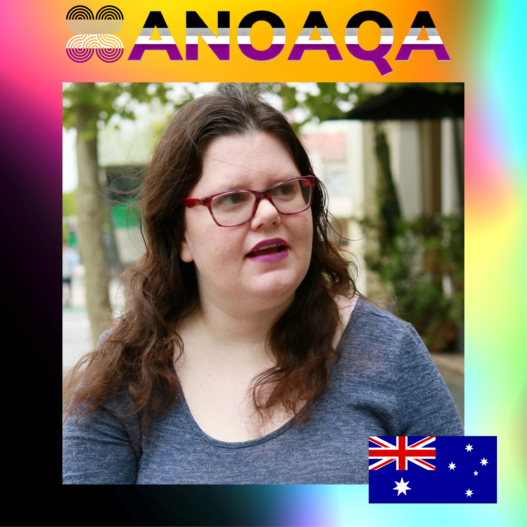
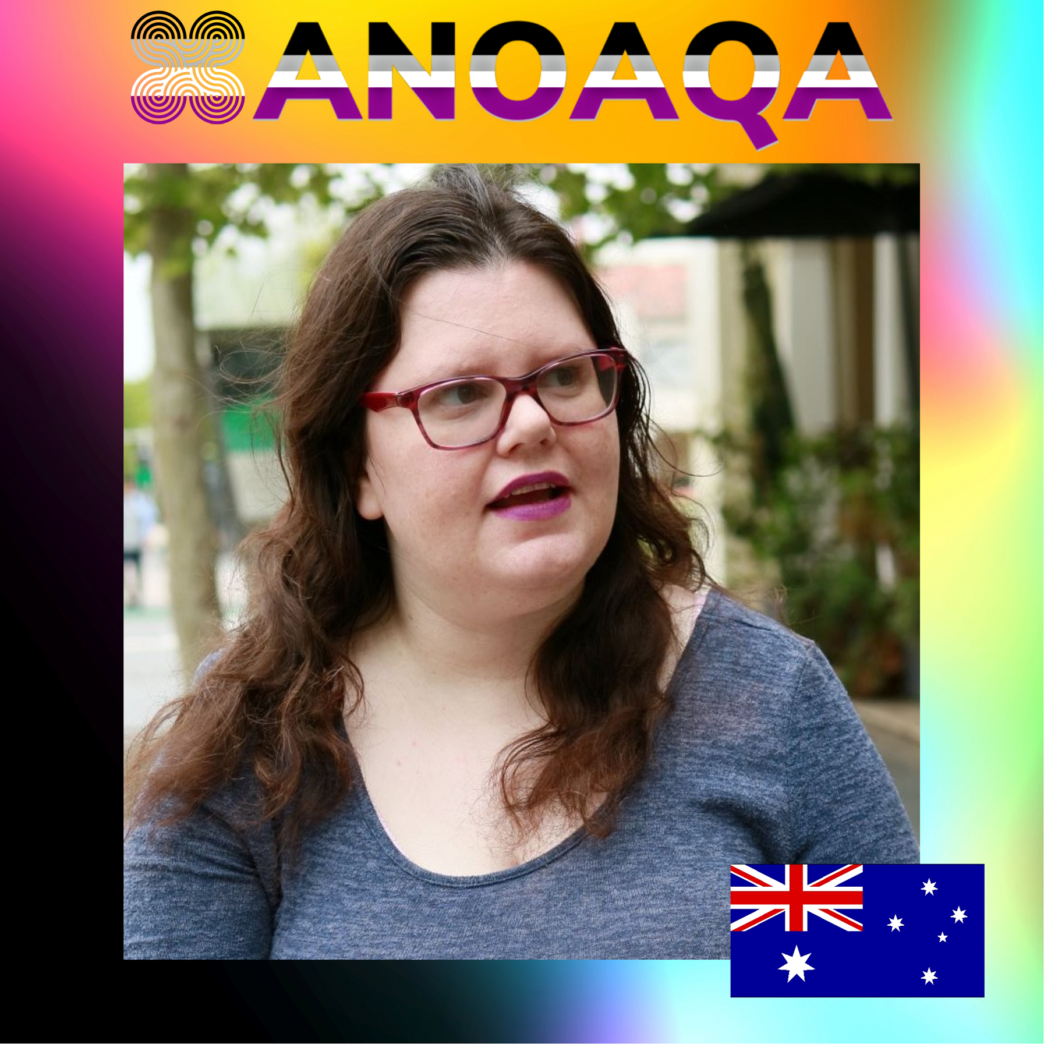
- Kate, thank you for joining us. Can you tell us about your journey into ace and aro activism? What compelled you to co-found The Ace & Aro Collective, and how did your political values evolve through that work?
The Ace & Aro Collective came about because there’s a lot of small groups around the different cities and states in Australia. When any of them want to hold an event, or apply for grant money, those kinds of things require engaging with bureaucracy and applying for permits, insurance. You need bank accounts, formal constitutions and other official infrastructure. We thought that rather than each individual group going through these processes – and some groups don’t want to be formalized like this -we’d form a national group. Then, as members, all the little groups could have access to our infrastructure.
We wanted to be able to use our size, experience and capacity to reach out to the ace and aros in neighboring countries – especially in the Pacific region, where we know that small populations mean small numbers of ace and aro people, who have less opportunity to find and engage with one another than in places with large populations. We felt concern about small countries being left out and excluded as “too small” to worry about – aren’t our neighbors, as some of the smallest countries in the world, in terms of both population and physical size, more in need of attention because they are neglected? Not less.
How have my political values evolved? Being involved with AACAU has given me the opportunity to interact with so many people outside of Australia – from South America, all over Asia, in the Pacific. I’ve learned so much about the issues that concern aces, aros and queer people as a whole, across the whole world. It really showed me how insular some of the queer community in Australia can be and how little is understood about the struggle worldwide. That’s really changed the way that I advocate, and that I speak when I’m in community. I hear a lot of “that doesn’t happen anymore” or “who cares about that?” and it really raises my temperature! I’ve become the person who is forever pointing out that your experience, whoever the speaker might be, is not everyone’s experience and that the world is a big place with a lot of struggles still being fought. We didn’t get rid of queerphobia because Australia legalized same-sex marriage.
- Many queer spaces pride themselves on ‘diversity’ but often erase ace/aro voices. What was the tipping point that led you to co-found The Ace and Aro Collective, and how did your identity shape the kind of politics you wanted to practice?
I don’t have an answer to this.
- You’ve spoken against the empty visibility offered by institutions while ignoring structural demands. What does tokenism in asexual representation look like to you—and how do you resist being co-opted?
I’m so tired of being consulted, of being permitted to speak, of sitting on committees and on boards, and without seeing any real change for the ace/aro communities as a result. I’m quite exhausted from being allowed to have “representation” that doesn’t make even a small change.
I mean this in really significant ways, such as my Government’s issue with understanding non-romantic monogamous relationships, and the urgent need for our voices to be included in discussions about domestic and sexual violence. But it’s also in small ways. If you are calling your conference an LGBTQIA+ conference – as some do in Australia – don’t allow your presenters to discriminate against the A. Insist they include it in the names of their presentations and investigate their work to make sure they are not actively anti-asexual/aromantic in their organization.
- Mainstream Pride spaces often package us into digestible narratives. What does “visibility” mean to you when it is not paired with power, funding, or platform control?
When writing our organizational values, AACAU specifically rejected “Visibility” and “Awareness” in favour of “Advocacy” – a much more action-focused word. Visibility does not give me the capacity to change anything, and no amount of awareness will actually advance government policy. That requires these things you mention – power, funding, the ability to connect with the people that can make real changes.
Aromanticism has a little ways to go. But I think asexuality has achieved a pretty high level of visibility now – and some people have seen us, and their reaction has been to laugh at us, to hate us, and to use violence against us. How is that helpful? We now need the capacity to fight against that.
- Why a caucus, not a conference? What radical potentials did the open-ended format of the ASEXUAL CAUCUS unlock—especially for those of us historically silenced?
The caucus is a common format in western-style conferences of this kind. I’ve attended and led them before at both queer and feminist conferences. In my opinion when they are very large, they can be easily derailed. They get bogged down in procedural business about who gets to speak when and how. Larger groups overwhelm smaller ones with their issues and big decisions are voted on, with some people inevitably put out because the “caucus” as a whole puts out a statement or opinion that they don’t agree with.
I love a smaller, intimate caucus like an asexual caucus. They usually become more like little gatherings, and I never attend a single one that isn’t for at least one or two people, the very first time they’ve been in the room with another asexual person. For me, that’s much more important than coming to any conclusions about what the asexual caucus at World Pride wants to declare to the world, as a group. What we want to say to one another, how we can support each other in that space, is more valuable to me than the politics.
It took so much effort and stress to get World Pride to give us that caucus, and I’m so glad we kept fighting because it was so worth it.
- With over 10+ participants from across continents—many from racialized, disabled, and non-Western contexts—what surprised you about how global ace solidarity emerged in the room?
You know – I wasn’t surprised at all. It was exactly how my experience of asexual/aromantic caucuses always goes – but more exciting because of the global scale of it. I was thrilled by the number of people who attended. More than I expected. One person came in, because they’d intended to go to a different caucus (and that’s what their delegation expected of them) but they saw our sign and said “Wow.” They had never met another asexual person before and for them, it was such an emotional experience to walk into a room of people from different countries who they instantly had a connection to share with. They were in tears to feel that solidarity.
I also think it’s incredible – and again the advantage of a small group – that this little group were there throughout the rest of the conference to support each other and hang out together.
- Can you share an unexpected or uncomfortable conversation from the ASEXUAL CAUCUS that felt important—something that wouldn’t have been possible in a polished, NGO-sponsored panel?
I think the conversations about what aspects of the conference were making the group feel unwelcome were really valuable. That was a conference that had made pretty clear that it didn’t value the participation of asexual people – so though my notes probably weren’t much regarded by those organisers, I do still have them. I hope they can be valuable in the future. I hope that the organisers of the next World Pride found them helpful.
Did you face any resistance or erasure from the official World Pride 2023 organizers? In your view, who still holds the gatekeeping power in global queer organizing—and how do we break it?
I faced an enormous amount of resistance and erasure. It’s a story that I don’t want to publicly tell. But I will say it was an incredibly stressful nine months of fighting for whatever time we could get for any asexual to be on any stage during that time, and I was exhausted by the end.
As to who holds the gatekeeping power? I would say they are commonly white/western/anglophone. They are cis and generally able-bodied gay or lesbian people who have a lot of experience on boards and committees. They’re good at the kind of governance that has become “the way things are done”.
- How did the ASEXUAL CAUCUS confront internal issues—such as white privilege, transphobia, anti-Blackness, or colonial narratives—within ace/aro spaces themselves?
I don’t have an answer to this – I did not take notes on this because this was a private conversation. It was discussed, and the white members of the group tried to learn and not talk too much.
- Some South Asian, Indigenous, and Latinx ace/aro activists brought experiences of criminalization, forced marriage, and spiritual erasure. How did these narratives reshape the Western-centric lens of the caucus?
I think I can say, without having notes, that I remember vividly that this was a big learning experience for some of the Australian people who were there. I remember seeing that in them, and recognising that same feeling in myself when I was first learning about the same things.
It really changes the conversation when people learn that their own experience is not universal. I don’t want anyone to feel that their experiences are not important! Everyone is important. But I think for some people it’s very eye-opening just how much oppression asexual people face in other countries – especially systemic and cultural oppression that we don’t experience here.
- As a Board Member of ANOAQA.ORG, your presence with Dipa Mahbuba Yasmin at the Asexual Caucus during World Pride 2023 sent a strong message against global ace-phobia and tokenism. What emotions or messages from the Global South stayed with you? In that space of shared resistance, what resonated most — as an activist, a representative of ANOAQA.ORG, and a witness to the ongoing fight against erasure?
One thing that really stuck with me was the solidarity that asexual people held with one another, often feeling that bond and desire to stay connected, even if they were attending specifically to represent some other part of their identity. For some, that other identity even lost a little less importance for a time, because the pull to share space and be validated by others who understood that part of them was so strong. As someone who is so active in my local and national asexual/aromantic communities, I sometimes forget the loneliness.
I have spoken a lot, I think, about the necessity of listening to ace/aro voices from outside of the western and anglophone perspective. I’m wary of talking too much about it myself, because I want to draw attention to that conversation, rather than, as a white person, insert myself into it.
- Was there any effort to archive, document, or preserve the conversations that took place? What would a living, breathing memory of this space look like for future generations?
A caucus is, by its nature intended to be a private and undocumented space where everybody has their right to privacy and to speak entirely freely. Only the outcomes of discussion are ever reported. I documented specifically what I thought was most important for reporting – I wanted to know what future World Prides could do to ensure a more welcoming environment for the ace/aro community and to encourage greater participation. Those notes were anonymous.
That being said, I don’t think that a gathering of asexual/aromantic people of this kind cannot be archived or documented. I know pictures were taken with consent, and I think that’s incredible, because candid photography shows people at their most genuine. I’d love to see a space like that, which can be documented and recorded. I just don’t myself know what it looks like.
- The most transformative activist spaces often don’t come from funding—but from trust and radical honesty. How did the volunteer nature of this project challenge or deepen the outcomes?
(I really can’t answer this and I can tell you why privately)
- How can queer movements stop treating ace/aro inclusion as a checkbox and instead redistribute resources, decision-making, and leadership? What’s one uncomfortable truth queer institutions must face?
I want to say first of all, that asexuality/aromanticism isn’t the only gap that needs to be filled. We still don’t see enough high-level representation from intersex people. There are very little trans and nonbinary people in positions of decision-making and leadership.
Queer institutions need to confront their own biases and prejudices. There is a lot of lateral violence and even those who consider themselves allies are still in their mind thinking things like “Oh, I’m fine with XYZ Identity, but they don’t have the same problems as…”
We all have different problems – but we are all in this fight together.
- Looking forward to future global Prides: If you had full creative and political control, what would an ace-led, justice-centered, anti-tokenist Pride look like?
This is a difficult question, because the kind of Pride I would want would never allow me, a single person, to have sole control over it! I’m here for an anarchist Pride. It would be untidy. There would be no attempt to soften anybody so that they resemble heteronormative structures in an attempt to appeal to greater society. I want a Pride that is as genuine, as varied, as fabulously authentic and individual and messy and weird as the real people in the community. It wouldn’t be sanitized or commercialized.
For my sex-repulsed aces (like myself) that’s not the same as to say it would be somehow compulsorily hypersexualized, because when I object to the “sanitization” of Pride, I am not talking about sex. I would certainly want a sex-positive Pride. And sex-positivity must by nature include positivity about the choice (or necessity) not to have sex. Which to me includes the right to express your sexuality if you choose to, your masculinity, your femininity, or neither. It also includes your right not to participate and to be respected in that, and to have spaces free of sexualized behavior.
When I talk about the “sanitization”, what I mean is making spaces palatable to those who belong outside of them. I mean a queer-platonic pair being forced to fit themselves into a “lesbian couple” box because that is a label that can be understood and recognized by a heteronormative society that is still getting used to lesbians – as long as their relationship mirrors a heterosexual marriage. Sanitization is a trans woman feeling she must attend as a drag queen – because to some, a gay man who dresses and “performs” as a woman is more palatable than a trans woman. There are bi people who feel afraid to attend Pride because they are currently with a different-gender partner, and many (including within our own community) regards them as straight because they can’t conceptualize what bisexuality is.
I want a Pride where every person feels free to attend as their absolutely authentic self, even if being a nonbinary bisexual asexual lesbian is a label that is “untidy” or “doesn’t make sense” to other people. That’s who YOU ARE, and you should be allowed to be that at Pride.