





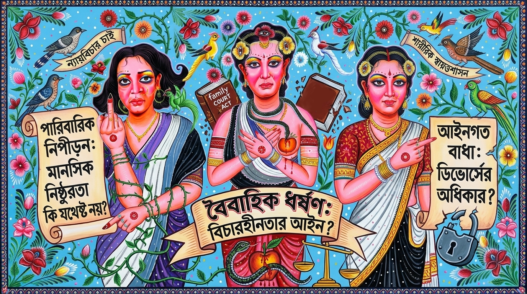
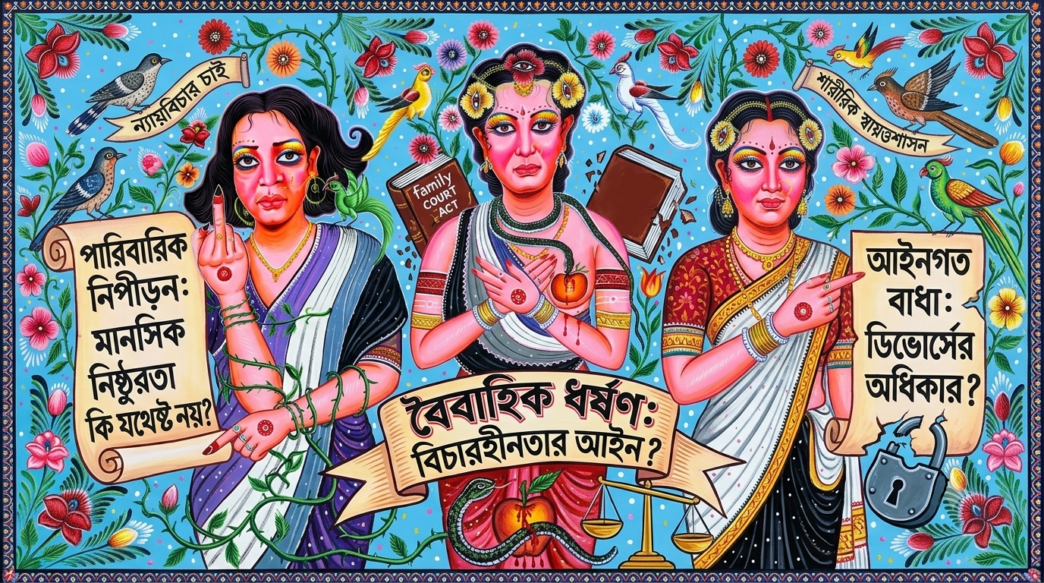
The current legislative landscape in Bangladesh creates a precarious dichotomy for women seeking protection from marital rape. While the Penal Code of 1860 maintains a statutory exemption for marital rape—thereby decriminalizing non-consensual sexual acts within the marital union—the Dissolution of Muslim Marriages Act, 1939, provides a civil pathway for survivors to seek marital dissolution on the grounds of “cruelty.” This structural misalignment forces survivors to navigate a legal system that often fails to categorize sexual coercion as a criminal violation, relegating it instead to a broad and often subjectively interpreted category of domestic hardship. Understanding this framework is essential for acknowledging both the limited agency afforded to survivors under current law and the institutional barriers that impede justice and bodily autonomy.
The following analysis examines the efficacy of the “cruelty” provision, the systemic loopholes inherent in the current statutory framework, and the challenges faced by survivors in substantiating claims within a judicial system that traditionally prioritizes the sanctity of the marital contract over the protections of the individual.
Legal Inequality in Divorce Rights for Women in Bangladesh
1. Delegated Divorce (Talaq-i-Tafweez)
This right only permits a woman to divorce her husband if he has expressly delegated that authority to her in the Kabin-Nama (marriage contract). Source
- How it works: If this clause is included in the marriage contract, the wife can exercise this right to divorce her husband without needing his consent or a court decree. Source
- Process: Like a husband’s talaq, she must provide written notice to the local government authority (Union Parishad Chairman/Pourashava Mayor) and her husband, followed by a 90-day waiting period for reconciliation. Source
2. Judicial Divorce (Under the 1939 Act) Source
If a woman does not have the delegated right of talaq, she can apply to a Family Court for the dissolution of her marriage under Section 2 of the Dissolution of Muslim Marriages Act, 1939. The law specifies nine grounds upon which a woman may petition the court for a decree of divorce:
- Missing Husband: The husband’s whereabouts have been unknown for four years.
- Failure to Maintain: The husband has failed to provide maintenance for two years.
- Imprisonment: The husband has been sentenced to imprisonment for seven years or more.
- Failure to Perform Marital Obligations: The husband has failed to perform marital obligations for three years without reasonable cause.
- Impotence: The husband was impotent at the time of marriage and remains so.
- Insanity or Disease: The husband has been insane for two years or is suffering from a virulent venereal disease.
- Option of Puberty: If she was married by a guardian before age 15 and repudiates the marriage before age 18 (provided the marriage was not consummated). Source
- Cruelty: Including habitual assault, associating with women of ill repute, attempting to force her into an immoral life, disposing of her property, obstructing her religious practice, or failing to treat her equitably if he has more than one wife.
- Any other ground: Any other ground recognized as valid for the dissolution of marriage under Muslim Law.
3. Mutual Consent (Khula or Mubarat)
- Khula: This is initiated by the wife, often involving an agreement where she may waive her dower (mahr) or other financial claims in exchange for the husband’s agreement to the divorce.
- Mubarat: This represents a mutual, amicable separation where both spouses agree to end the marriage.
Examining the Legal Status of Marital Rape and Women’s Pursuit of Justice
1. Legal Denial of Marital Rape
Under the current Penal Code of 1860 in Bangladesh, there is a legal exemption for marital rape: sexual intercourse by a man with his own wife (provided she is not under the age of 13) is not considered rape under the law. Because of this specific legal exemption, a woman cannot file a criminal case for “rape” against her husband if she is over 13, as the law does not recognize it as a criminal offense.
2. Seeking Divorce Based on Such Conduct
Source
While “marital rape” is not a criminal ground for divorce due to the statutory exemption, a woman who is subjected to forced sexual acts or violence by her husband is not without legal recourse in family court. She can pursue a divorce under the Dissolution of Muslim Marriages Act, 1939, primarily by citing “Cruelty”.
Under Section 2(viii) of the Act, a woman is entitled to a decree of dissolution of marriage if her husband treats her with “cruelty”. The law defines cruelty broadly, which includes:
- Habitual assault or making her life miserable by cruel conduct, even if the conduct does not amount to physical pain.
- Any conduct that is considered legally cruel, which courts have increasingly interpreted to include severe emotional and physical abuse within the marriage.
The discourse surrounding marital sexual violence in Bangladesh remains constrained by a rigid intersection of cultural expectations and outdated legal statutes. While the Dissolution of Muslim Marriages Act, 1939, serves as the primary mechanism through which women may seek relief from an untenable marriage, the efficacy of this statute is severely undermined by the persistent invisibility of marital rape within the broader legal framework.
The “Cruelty” Provision as a Legal Conduit
Under Section 2(viii) of the 1939 Act, a petition for the dissolution of marriage may be granted on the grounds of “cruelty.” In the absence of specific criminal legislation regarding marital rape, this provision remains the most viable legal avenue for survivors. The law broadly defines cruelty to encompass habitual assault, conduct that renders life miserable, and behaviors that obstruct religious or personal autonomy.
Within academic and legal interpretations, there is a burgeoning acknowledgment that “cruelty” is not confined to physical injury. It extends to psychological subjugation and the coercion of sexual acts, which fundamentally violate a spouse’s dignity and bodily autonomy. Consequently, legal practitioners may frame forced sexual acts within the broader rubric of “cruelty” to satisfy the court’s requirements for dissolution, even in the absence of forensic evidence such as physical trauma.
Systemic Barriers and Legal Loopholes
Despite the utility of the “cruelty” provision, survivors face systemic hurdles that inhibit their access to justice:
- The Marital Rape Exemption: The most significant barrier remains the exemption found in the Penal Code of 1860, which precludes the classification of non-consensual intercourse as “rape” within a marriage. This statutory loophole creates a hierarchical legal structure where marital sexual violence is effectively decriminalized, delegitimizing the survivor’s experience before they even enter a family court.
- The Burden of Proof: Family courts in Bangladesh operate under civil standards of evidence. Without criminal statutes to support claims of sexual violence, the burden rests heavily upon the petitioner to substantiate “cruelty.” The demand for physical evidence—often framed as the “gold standard” for proof—creates a near-impossible barrier for survivors whose abuse is primarily psychological or non-violent in a physical sense.
- Socio-Cultural Normalization: The cultural perception of sexual compliance as a “compulsory marital duty” creates a profound disconnect between legal theory and social reality. This normalization often influences judicial discretion, as judges may be hesitant to interpret sexual coercion as “cruelty” when society at large views it as an expected facet of the marital contract.
- Corroborative Evidence Deficits: Because domestic abuse often occurs in private, survivors frequently lack the external documentation—such as medical reports or witness testimonies—required to satisfy the court. Reliance on informal mechanisms like General Diaries (GD) or testimony from acquaintances, while useful, remains subject to the court’s subjective evaluation, leading to inconsistent legal outcomes.
Conclusion
The reliance on the Dissolution of Muslim Marriages Act to address sexual coercion within marriage is a testament to the lack of dedicated legislative tools. For survivors, the legal system serves as a narrow corridor; while the “cruelty” provision offers a path toward separation, it fails to address the underlying criminal nature of sexual violence by spouse. Until the legal framework evolves to recognize bodily autonomy within marriage independent of the “cruelty” metric, survivors will continue to face institutionalized barriers that prioritize the preservation of the marital institution over the fundamental human rights of the individual.
Recommendation
ANOAQA advises that you do not have to endure an abusive situation. We understand that there can be many barriers and complications when trying to leave or seek help. While every situation is different, we encourage you to do what you can within your own limits and circumstances.
Because the law can be complex regarding how “cruelty” or abuse is interpreted, it is highly recommended that you:
- Consult a Family Lawyer: A lawyer specializing in the Dissolution of Muslim Marriages Act can help you draft a petition that focuses on “cruelty” and “unbearable treatment,” which are legal grounds for divorce, without needing to prove “rape” in a criminal court.
- Contact Support Services: Organizations like Ain o Salish Kendra (ASK) in Bangladesh provide legal aid and support for women facing domestic violence. They are experienced in helping women navigate these exact situations.
Disclaimer: This response is intended for educational purposes only and does not constitute formal legal advice. Legal practitioners and those seeking assistance should consult with qualified human rights organizations or legal aid societies specializing in family law within the Bangladeshi context.