

Summary
Neel Kantho (b. 1988) was born and raised in a major city in Bangladesh. Her early life was marked by the familiar rhythms of urban childhood: crowded schools, congested streets, and the endless negotiation between tradition and modernity. Yet as she reached adolescence and adulthood, she encountered the darker realities of her society—exploitation, harassment, and betrayal that rendered the city itself a site of danger.
Rather than retreat, Neel Kantho resisted. She entered regional politics, learning quickly that survival in the city demanded not only resilience but also the ability to wield power in spaces long dominated by men. By her mid-thirties, she had become both a survivor and a strategist—her politics less about ideology than about protection, dignity, and visibility.
Biographical Information:
- Name: Neel Kantho (pseudonym),
- Age: 35
- Place of Birth: Born and raised in Barishal, Dhaka
- Current Residence: Mirpur
- Languages Spoken: Bengali
ANOAQA Interviewer: How would you describe your identity?
A: I am probably agender and asexual. However, I cannot say for sure whether I am aromantic, though romantic love doesn’t come easily to me. Actually, I questioned my own identity for a long time. Growing up, there was no system in Bangladesh to diagnose minor neurodivergences, so I never knew if they played a role in my behaviors.
Growing up in Bangladesh, there wasn’t much awareness about gender identity or pronouns either, because the Bengali language does not use gender-specific pronouns. Therefore, I don’t mind being referred to as “she/her” when speaking in English.
Q: Tell us about your childhood.
A: My life started in a joint family. I grew up in a traditional Muslim family, with my father’s side being Sharia-observing and my mother’s side following Marfati traditions. We lived in a joint family household. I was very close to my father’s younger siblings. In particular, one of my uncles took care of me almost like his own child. I followed him so much that at one point, my biological parents started getting annoyed by it. I felt a stronger bond with my uncle and aunt than with my own parents.
Q: Did that relationship break down at some point?
A: Yes. Eventually, a dispute arose between my mother and my uncle. My mother forbade me from going to him. But I was only a three-year-old child back then; I understood my mother’s prohibition, but I couldn’t live without my uncle, so I would secretly go out with him.
One day, my mother caught us and beat me severely. Then my uncle protested. The matter gradually escalated into a major family feud. At one point, my father told both of his siblings to leave the house. That day, our joint family was shattered.
Q: What impact did that incident have on you? A: I cried a lot. I wanted to go with my uncle, but my parents wouldn’t let me go. I think that’s where the idea formed inside me that I needed to find an alternative family somewhere where I would be safe. It felt like I was always searching for a “safe home.”
Later on, I realized that this is perhaps why I used to get attached to people very quickly. If I liked someone, I felt like going away with them—just like how, as a child, I wanted to go to my teacher’s house with her.
Q: Tell us something about your school life.
A: I started school at about four years old. Back then, education began with playgroup, nursery, and kindergarten. I really liked my playgroup teacher. Even after school hours, I didn’t want to go home with my parents; I wanted to go to that teacher’s house with her.
One day, the teacher was walking home. I didn’t want to let her go and pulled on her orna (scarf). Accidentally, the scarf got wrapped around her neck, and the situation turned dangerous. Other people rushed over and made sure she was safe. The incident later reached the school’s headmaster.
Q: What did the principal say?
A: He called my parents and told them that I might be a “special child” and that the school could not provide the necessary facilities for me. They said they had no personal complaints against me, but my behavior made them fear that another child might get hurt.
My parents later spoke to that teacher and paid her to come to our home and tutor me. They also requested the school authorities to at least let me come to school during final exams so I could take the tests and be promoted to the next grade.
Q: When did you finally return to the regular classroom?
A: In the middle of the third grade, we moved to the other side of the city, and in the fourth grade, I enrolled in a new school. It was an all-girls school.
Q: What was your experience like then? A: It was a very new experience. Having spent a lot of time being and growing up alone, suddenly being among so many people was difficult for me.
There were about a hundred girls in our class, with four or five sitting on each bench. Every day, a few students would be absent. I would search around to find the bench where someone was missing, go there, and sit by myself. Talking to people every day and socializing felt extremely exhausting to me from then on.
Q: Yet you mentioned you had a curiosity about people.
A: Yes, and perhaps that is the contradiction of my life. It was hard for me to mix with people, but I had an intense curiosity about them. And if I liked someone, I would get emotionally attached to them very quickly—not in a romantic way, mind you. It felt as though I suddenly wanted to consider that new person a very close, very safe haven in my life.
However, people often took advantage of that. From childhood into my teens, I was repeatedly sexually abused by various different men.
Q: Did your mother notice this?
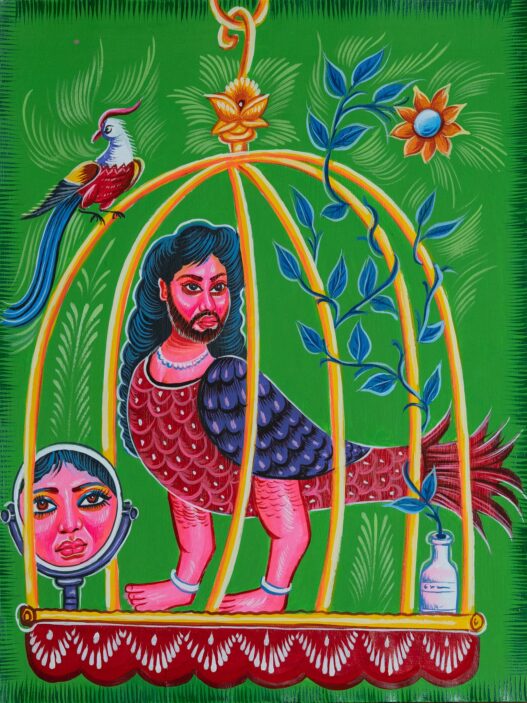
A: Very much so. From the fourth grade until my secondary board exams, my mother brought me to school almost every day and sat outside the classroom. She kept an eye on who I was talking to and who I was sitting with. Yet, that surveillance made me feel even more helpless; I began to feel like a bird trapped in a cage.
My mother wanted to control my interactions with everyone, regardless of gender. If I sat next to a girl she didn’t like, she would tell me, “That girl is bad, she will harm you—just wait and see.” Her scare tactics started developing a phobia inside me. On the other hand, she would pick someone herself and forcefully declare, “From today, this is your friend; you will sit next to her.”
But I couldn’t find friendship with the kids my mother chose. Eventually, sitting alone became comforting to me. For the rest of my school life, I almost always sought out an empty bench to sit by myself.
Q: What was your worst experience during your school life?
A: In the 1990s, corporal punishment was very common in schools. After a while, I noticed that many students were bringing doctors’ prescriptions to escape the teachers’ beatings. The prescriptions would read: “Rheumatic fever, no corporal punishment allowed.”
When I first joined that school, I wondered, is rheumatic fever a contagious disease? How did almost everyone get infected with the exact same illness? Later I learned that many students had coaxed and convinced their parents to obtain such prescriptions.
Q: Did you ever arrange for something like that yourself?
A: No. From the fourth grade until my board exams, I stayed in that same school and got beaten every single day. I didn’t tell my parents anything. Instead, I gradually began to realize that teachers probably wanted students to cry when being beaten and plead, “Sir, please don’t hit me anymore.” But I never did that.
Q: Why? Were you trying to prove yourself tough?
A: Yes! Especially male teachers absolutely disliked tough-minded students and girls. I felt that the fact I wasn’t afraid of the beatings or the pain annoyed them even more, or perhaps bruised their male egos. As a result, they would hit me harder to vent their anger. Although later on, I heard from many tomboy friends that the exact same thing happened to them during their school lives.
On the other hand, the girls were surprised. Some of them would ask me, “How can we help you?” or “Don’t you feel pain?”
One day I told them, “I have become pain-resistant. When I am hit, I am not afraid, nor do I feel pain. You don’t need to worry about me.”
Q: Did you ever fall in love during your school life?
A: Yes. A classmate (a girl) became very fond of me. At first, she told me she wanted to take care of me, and that after school we could go to her house together for private tutoring. She even went and convinced my mother herself.
That’s how my regular visits to her house began. Eventually, she confessed her feelings to me. And I noticed that I found her physically attractive, but purely from a distance just to look at. Naked female bodies fascinated me immensely, but I felt indifferent toward sex.
Our school was a Bengali-medium school in the 1990s—long before computers, phones, or the internet existed. There was no homophobia back then either. A girl even wrote a letter to another using her own blood, but nobody panicked or developed a phobia over it. Intimacy between girls wasn’t questioned back then the way it is today. At least at our school, we never faced insults or taunts for being a girl in love with another girl.
Q: Did you feel romantic attraction toward her?
A: I still cannot easily explain that. It seemed she felt a physical attraction toward me; perhaps she was bisexual.
In my case, however, it was more about emotion. I had gotten involved with her very deeply. She had become a safe person for me.
Q: Was there a difference between your experiences with men and women?
A: There was a profound difference.
My own gender expression and behavior perhaps seemed somewhat different to people, too. Often, I received aggressive behavior from men, and I had to toughen myself up against that. A male member of my family sexually abused me for a long time. On the other hand, a woman brought tenderness and love into my life. Therefore, men often became synonymous with panic, harshness, and fear to me, while women represented gentleness and safety.
Q: How long did your relationship with that girl last?
A: A little over two years. Later, a boy entered her life. When her family found out, she was eventually married off to that boy.
I was curious about the whole thing because I didn’t feel the kind of attraction toward boys that she did. But my dependence on her was very heavy. When she got married and left, I became very lonely all over again.
Q: Was that a psychological trauma?
A: To a large extent. I gradually began to condition myself not to depend on anyone ever again. After a while, it felt as though love, sex, and all such human emotions could no longer touch me.
Q: Is that when you started thinking of yourself as asexual?
A: No, no! These are stories from my school days. In fact, for many years after that, I remained in doubt. I was nearly thirty years old when I finally discovered asexuality as my orientation.
Before that, I spent long years simply questioning myself. I used to wonder: Am I truly asexual? Or, given everything that has happened in my life, can I simply no longer trust anyone? Do I actually lack attraction, or have I built a wall to protect myself from emotion? Those questions haunted me for a long time.
Q: Did you also try to “FIX” yourself?
A: Yes. I heard so many taunts from family and neighbors throughout my life that sometimes I felt I had to change. I thought that if I could just be like others, I could become a “proper” human being. But I couldn’t.
As I grew older, I began to realize that perhaps there is nothing wrong with me. Perhaps the way I feel is my normality.
Q: So how do you view your orientation today?
A: Now, I try to comfortably express asexuality as part of my identity. However, I cannot explain every single feeling in my life with absolute certainty. The impact of my past experiences, my relationships with people, fear, the need for safety—everything likely plays a part.
Yet, after trying to change myself for so many years, I’ve come to feel that rather than thinking of oneself as flawed, it is better to accept oneself. Maybe I am asexual—and the events of my life have simply added more layers to that. And perhaps, for the first time, I just need to live life on my own terms without constantly questioning myself.